In a constantly shifting digital world, testing tools must adapt faster than ever before. Social media saga silktest isn’t just a trending keyword — it’s a signal for growing tensions between traditional enterprise test tools and modern, agile demands.
For businesses in 2025, Software QA is no longer about basic regression tests. It’s about delivering consistent content across channels like TikTok, Threads, or business apps such as Salesforce or Zoom—and doing it daily, even hourly. As digital platforms accelerate, testing strategies are being reevaluated deeply. This guide explores how SilkTest still holds relevance, where it falls short, and what modern teams can do to future-proof their test architecture.
TLDR: This guide is built for testers, QA leads, dev managers, and decision-makers seeking clarity on using or replacing older testing frameworks like SilkTest in fast-moving environments.
What Is the “Social Media Saga” with SilkTest?
The term “social media saga silktest” emerged among software testers in reference to the underlying struggle of using Micro Focus SilkTest (now part of OpenText) in fast-changing, consumer-facing app environments—specifically social media platforms.
The “saga” refers to:
- Friction between legacy tools and fast-moving UI updates on channels like Instagram or X.
- Testers feeling overwhelmed maintaining scripts in apps with weekly or daily UI changes.
- An ongoing debate: modernize SilkTest or replace entirely?
Despite these struggles, SilkTest continues to find place in structured enterprise environments.
The Evolution of SilkTest: Legacy to Modern Hybrid Testing
Social Media Saga SilkTest has been around for decades. Its goal hasn’t changed: provide robust functional and regression test automation, especially for GUI elements.
Major Evolutions Since 2020:
- Integration with Jenkins and GitLab for CI pipelines
- Browser compatibility updates
- Object recognition via AI (2023 additions)
- Limited cloud execution support via Silk Central
2025 status:
- Continues as a solid automation choice for Windows-heavy systems
- Fails to offer agility for fast-paced app teams and mobile-first products
Why Social Media Apps Break Traditional Tests
Social Media Saga SilkTest apps behave nothing like legacy enterprise dashboards. Their dynamic frontends, real-time interactions, and continuous UI experiments make test automation challenging.
Challenges for Tools Like SilkTest:
- Rapidly changing DOM structures
- Dynamic element IDs and async rendering
- Component-based architecture (React, Vue 4, Svelte)
SilkTest wasn’t built for this pace. Maintaining test scripts becomes a full-time battle.
Instead, frameworks like Playwright, Cypress, and now AI-powered testing tools are designed to handle this agility.
SilkTest Architecture Breakdown (2025 Version)
Core Components of SilkTest (Current Release):
| Component | Description |
|---|---|
| SilkTest Workbench | Script creation using VB.NET or keyword-driven UI |
| Silk4J/4NET | Test scripting integrated in Eclipse & Visual Studio |
| Silk Central | Test management and result analytics |
| Execution Engine | Manages local/cloud test runs |
| Object Map | Tracks and manages GUI objects |
While architecture is sound for static apps, it lacks recovery, self-healing, and test intelligence found in modern platforms.
How SilkTest Stacks Against Modern Automation Frameworks
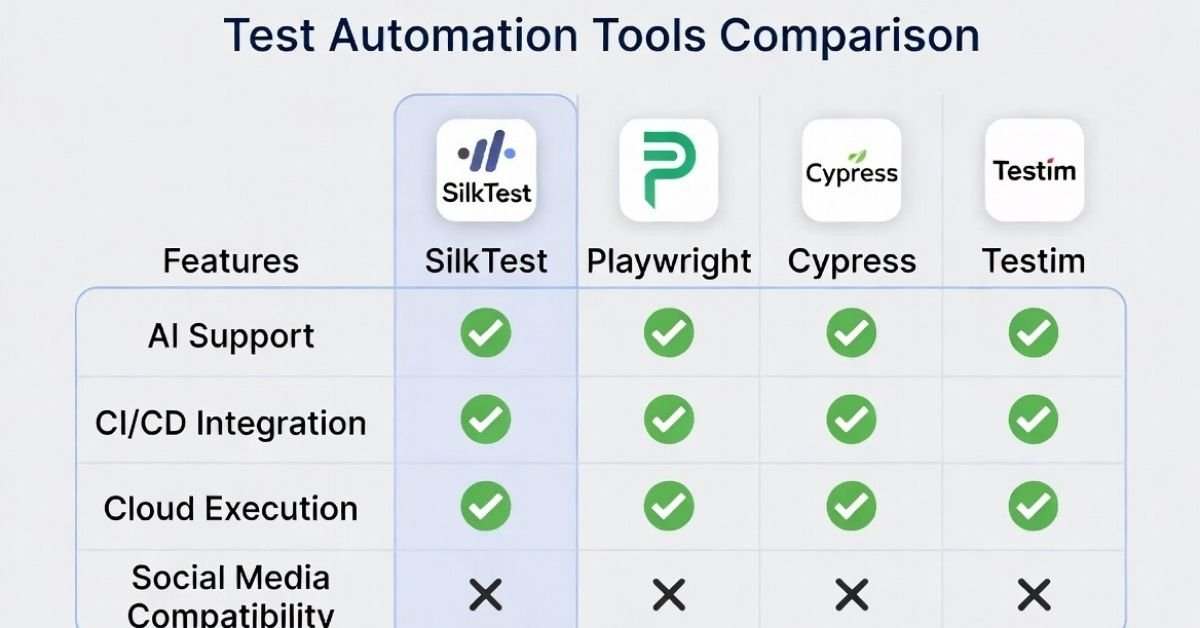
| Feature | SilkTest | Playwright | Cypress | Testim |
|---|---|---|---|---|
| AI-based Smart Locators | ❌ | ✅ | ⚠️ | ✅ |
| Cloud Execution | ⚠️ | ✅ | ✅ | ✅ |
| Real-Time Feedback | ❌ | ✅ | ✅ | ✅ |
| Scriptless Testing | ⚠️ | ❌ | ❌ | ✅ |
| Mobile Device Support | Limited | Strong | Moderate | Strong |
| Use by Social Platforms | Rare | Common | Some | Some |
Bottom line: SilkTest is excellent for legacy dashboards but outclassed for dynamic, evolving UIs.
Where Do Enterprises Still Prefer SilkTest Today?
Despite newer frameworks, SilkTest usage continues — especially in:
- Banking & Financial Systems
- Insurance Management Portals
- HR & Payroll Backoffs
- Classic ERP UIs (SAP, Oracle Forms)
These apps:
- Don’t change UI frequently
- Require durable, centralized test reporting
- Operate in controlled QA cycles
SilkTest + CI/CD: Is Real-Time Deployment Possible?
Social Media Saga SilkTest took a long time catching up with DevOps pipelines. As of 2025, the tool offers:
- Jenkins plug-ins
- Bamboo task runners
- XML/JSON result exports for dashboards
But compared to native CLI integrations with tools like Playwright or Selenium Grid, SilkTest still feels dated.
CI/CD works — but not cleanly. And in fast delivery teams, this lag costs time and metrics.
Visual Analysis: Side-by-Side Comparison Table
Test Automation Tool Capability Matrix (2025 Updated)
| Feature Category | SilkTest | Playwright | Testim | Katalon |
|---|---|---|---|---|
| Ease of Setup | ⭐⭐⭐ | ⭐⭐⭐⭐ | ⭐⭐⭐⭐ | ⭐⭐⭐ |
| Mobile Testing | ⭐⭐ | ⭐⭐⭐⭐ | ⭐⭐⭐⭐ | ⭐⭐⭐ |
| Visual Testing | ❌ | ✅ | ✅ | ✅ |
| Cross-browser Coverage | ✅ | ✅ | ✅ | ✅ |
| Cloud CI Integration | ⚠️ | ✅ | ✅ | ✅ |
| Pricing (2025) | Medium | Free | Expensive | Medium |
| Learning Curve | High | Medium | Low | Medium |
= Fully Supported | = Partial | = Not Supported
Future of GUI Testing in Agile Teams
Agile, product-focused teams need testing frameworks that meet the following:
- Generate tests from user sessions
- Detect UI anomalies in real time
- Self-repair broken tests
- Integrate cleanly into DevSecOps
SilkTest, though robust, doesn’t fully serve this vision — yet. Teams are investing heavily in AI-layered tests and observability-led testing beyond just pass/fail logic.
Roadmap for QA Teams: Retain or Replace SilkTest?
Social Media Saga SilkTest If your app’s UI changes:
- Monthly → Might still handle
- Weekly → Needs replacement
- Daily or hourly → Replace ASAP
Tips:
- Use SilkTest for stable enterprise systems.
- Introduce Playwright or Testim for flexible modules.
- Begin migration by tagging stable/volatile areas separately.
- Track ROI with defect trends tied to automation failures.
FAQs
Q1: Is SilkTest relevant for social media testing in 2025?
No, it lacks the agility and dynamic locators needed for fast-changing UIs.
Q2: What’s the best alternative to SilkTest today?
Playwright or Testim — both support dynamic web apps and CI/CD natively.
Q3: Can I use Social Media Saga SilkTest for hybrid applications?
Yes, partially — but with setup limitations for mobile and cross-platform tools.
Q4: Is SilkTest free?
No. It’s a commercial product with enterprise licensing.
Q5: Why do enterprises still use SilkTest?
Because it offers stability, especially in legacy apps that rarely change.
Conclusion
The social media saga silktest controversy isn’t about one tool—it’s about how fast our expectations of software delivery have changed. SilkTest was designed for long-term UI verification, not sprint-based web innovation. While it still holds value in enterprise settings, the testing world is moving to faster, smarter, AI-driven ecosystems.