Artículos en español
Una colección de artículos sobre investigación planetaria y exploración espacial en español.
Una colección de artículos sobre investigación planetaria y exploración espacial en español.

Una colección de artículos sobre investigación planetaria y exploración espacial en español.
Una colección de artículos sobre investigación planetaria y exploración espacial en español.

Some of the most massive galaxies in the Universe appear to be missing a lot of stars. That seems unusual, since birthing stars is one of a galaxy’s main tasks as it grows. According to Xin “Cindy” Xiang of the University of Michigan, something is suppressing or quenching the births of stars in these galaxies,…

What’s more, sunlight in summertime reaches the ground at an angle perpendicular to the surface — it comes straight at the ground. In winter, sunlight comes in at a sharper angle. This spreads the Sun’s light across a larger area, delivering less light — and therefore less warmth — per square meter. The differences in…

Orion and Gateway in Lunar Orbit. Credit: NASA Today, Interim NASA Administrator Sean Duffy reset NASA’s Moon program. Sean Duffy announced today that he was re-opening NASA’s HLS contract. As a justification, Duffy stated that SpaceX’s Starship lunar lander was behind schedule and its delays put at risk NASA landing astronauts on the Moon by…

It looks there for the taking, doesn’t it? The third rock from the sun just sitting there, all defenceless, run by squabbling politicians ruling over a human race who’d rather be sharing “get ready with me” videos than vigilantly watching the skies as they should be. But next time you set your sights on invading…

Back to Article List Here’s what’s launching June 29–July 5: a Pegasus XL carries a servicing spacecraft to reboost NASA’s Neil Gehrels Swift Observatory and ULA’s Atlas V delivers 29 more Amazon Leo broadband satellites to orbit. Katalyst Space Technologies engineers stabilize the LINK robotic servicing spacecraft as it enters a vibration chamber at NASA’s…
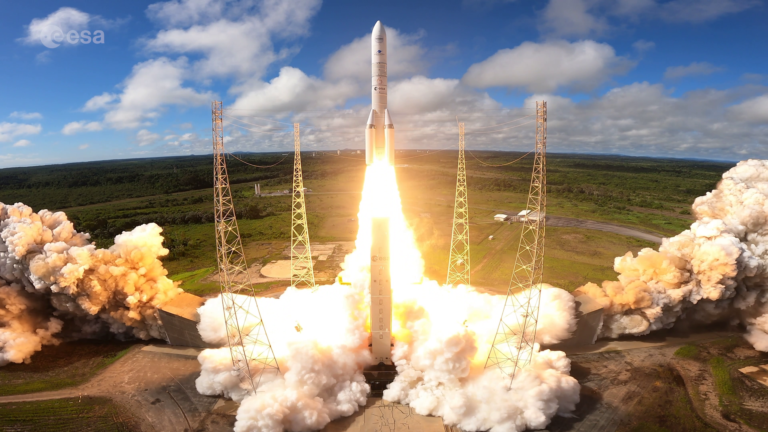
On 17 June at 09:21 local time (13:21 BST, 14:21 CEST), Ariane 6 flight VA269 soared to orbit from Europe’s Spaceport in French Guiana. 36 satellites for Amazon’s Leo constellation left Earth powered by four P160C-based boosters, the first time these upgraded boosters were used – making this launch the most powerful so far for…